Which TLD Is Worth Building On in 2026? .com, .ai, or Something Else
The TLD you pick shapes how people perceive your project before they ever see it. Here is when .com and .ai are worth paying for, and when an alternative is actually fine.
· 7 min read · SAIPX
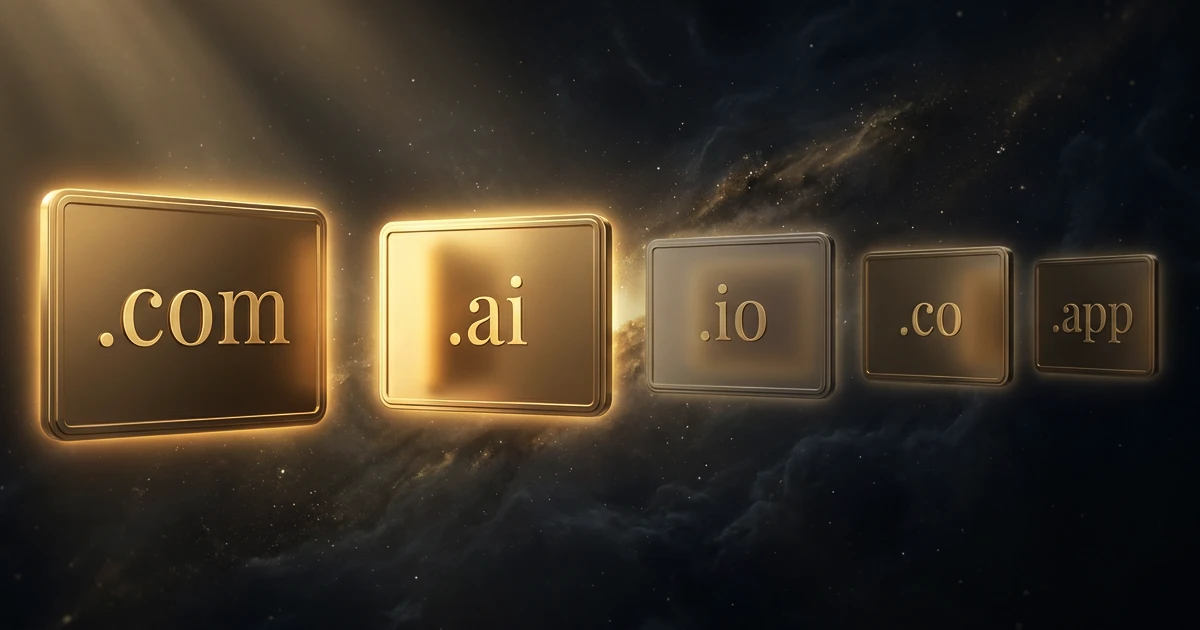
Every founder makes this decision. Usually in a rush, usually late at night, usually after the .com is taken. Someone typed their idea into a registrar, saw the green $9.99 option on some TLD they had never thought about, and told themselves it would be fine. Sometimes it is. Often it is not.
The domain extension you pick is the first thing a potential customer sees about your product. Before the pitch, before the homepage, before the logo. It sets expectations. Some TLDs carry weight by default. Others require you to spend years earning back what you lost in the first impression.
Here is how the landscape actually looks in 2026.
The two TLDs that still carry real weight
.com is still the default, still worth the premium
.com passed its 30th birthday a few years back and it refuses to hand over the crown. There are newer extensions. Shorter ones. More clever ones. People still type .com first.
This is not nostalgia. It is muscle memory. A [2023 GrowthBadger study](https://growthbadger.com/tld-study/) found that users were three to four times more likely to assume a business was legitimate when the domain ended in .com versus a newer gTLD, even when the rest of the brand was identical. A five-year retention comparison from Verisign shows .com domains are renewed at dramatically higher rates than any alternative. People hold onto them because they actually use them.
For consumer products, B2B software, media brands, and anything you plan to raise money on, .com is still the baseline. Not because it ranks better in search. Because it is the extension your customer's mother assumes exists.
The premium is real. Short, memorable .com names routinely trade in the four to seven figures. That feels absurd until you watch a competitor spend three years and half a marketing budget trying to pry users away from someone else's .com that happens to match their brand.
.ai is the second-tier standard that actually earned it
.ai is the only newer TLD to break out of category-specific usage and reach genuine mainstream recognition. When someone sees `something.ai`, they assume AI. That sounds obvious, but naming conventions almost never align that cleanly with public intuition.
Hugging Face, Character, Perplexity, Cursor, Anthropic's claude.ai, and most of the AI tools you actually use day-to-day either live on .ai or run it as a primary property. This was not always the case. Five years ago .ai was a novelty, and the two-letter country-code pricing felt steep. Now it is the expected extension for AI startups, and the .com variant is often the weaker choice. It implies the company is a legacy brand trying to bolt AI onto something else.
The ICANN-managed Anguilla registry has cleaned up the infrastructure. Renewal prices stabilized. The trust level is genuinely on par with .com for AI-specific products. A good .ai now commands premium pricing for the same reason a good .com does. It is scarce, and it signals the right thing instantly.
If you are building in or around AI, .ai is often the right answer even when the .com is available.
The honest case for alternative TLDs
Now the part most domain sellers will not admit. You do not always need a premium TLD. For a lot of projects, you actively should not pay for one.
When alternatives work fine
Indie tools, hobby projects, internal products, side hustles. If you are a solo developer shipping a Chrome extension, a small SaaS, a dev tool that lives or dies by word of mouth in a specific technical community, then .io, .dev, .app, .co, .fun, .xyz or even .now are fine. Your audience is small, technical, and pattern-matched to alternative extensions. They will not blink.
Developer-focused products have the longest leash on TLD choice. .dev, .io, .app, .sh all carry signal inside those communities. GitHub Pages on .io, countless open-source tools on .dev, Bun on .sh. Inside the technical bubble, these read as native. Outside it, they register as "that thing I can never remember how to spell."
Niche communities also tolerate alternatives. Audiences small enough that organic word-of-mouth carries the brand. If 500 people are your entire market and they find you through a Twitter thread, the TLD barely matters.
There is one notable exception worth calling out, because it looks like a counterargument but is actually the opposite.
Lovable.dev is one of the fastest-growing startups on the planet, and it is explicitly built for non-technical users who want to ship a website without writing code. By every conventional metric they should have gone .com from day one. Instead, lovable.com is an underwear brand.
They survive it because the product is genuinely that good and the category was new enough that they owned the mindshare before anyone thought to check the .com. But that is not a strategy. That is luck on top of execution. Every time someone shares Lovable by name at a dinner party, some percentage of listeners type lovable.com, land on underwear, and never make it to the actual product. The company is big enough to eat that loss. Most are not.
The takeaway is not "Lovable proves .dev works for consumer products." The takeaway is that if Lovable had launched on lovable.com, they would probably be bigger, and they would not spend the next decade quietly trying to buy it.
Where alternatives break down
The moment you try to scale outside the technical bubble, the friction compounds fast.
Consumer products suffer the most. Normal users type .com by default. You will watch analytics show you a steady trickle of traffic going to whoever owns the .com of your name, and there is nothing you can do about it short of buying it.
Enterprise sales surface the TLD issue on every call. A CTO will pattern-match a .xyz email address in a security review and flag it. Procurement will ask why the vendor does not have a "real" domain. You end up explaining your TLD choice instead of selling the product.
Trust-heavy categories like finance, healthcare, legal, B2B security basically require .com or a strong regional TLD. Nobody wires money to a .biz.
.io specifically has lost ground. The [2024 announcement](https://www.theregister.com/2024/10/08/uk_british_indian_ocean_territory/) that the British Indian Ocean Territory would transfer sovereignty created real uncertainty about .io's long-term future. It is still widely used and still functional, but the premium has softened. Some startups are quietly moving off it as a precaution.
A simple decision framework
Ignore the marketing from new TLD registries. Ask these questions instead.
1. **Who is typing your domain?** Technical users tolerate anything. Consumers type .com. The bigger your target audience, the more .com matters.
2. **How will people hear about you?** If your growth is word-of-mouth at conferences or podcasts, someone will say your name and the listener will type `.com` automatically. If your growth is through direct clicks from Product Hunt or GitHub, the TLD matters less.
3. **What is the worst case if the .com owner builds a competitor?** Sometimes minimal. Sometimes brand-ending. Think about this before you commit.
4. **Can you afford the premium?** .com names for any reasonable word cost real money now. If the budget does not exist and the product is early, a strong alternative TLD is better than a weak .com compromise. You can always trade up later. Plenty of brands have.
5. **Is this permanent or a stepping stone?** Launching on .app or .io with a plan to acquire the .com once there is traction is a legitimate strategy. Launching on .biz and hoping nobody notices is not.
The uncomfortable truth about "clever" TLDs
You see it sometimes. A brand picks a TLD specifically because it makes the domain read as a sentence. `late.ly`, `del.icio.us`, `visit.us`. It is cute. It also tends to age badly and confuse people who have never encountered the pattern.
The exceptions are rare and specific. Most of the time, what feels clever to the founder reads as "I could not afford the real domain" to everyone else. That is not fatal, but it is not free either.
Our take, from inside the market
We sell .com and .ai. That is not an accident. It is what holds value, what gets acquired, and what our customers are willing to spend real money on five years after they buy it.
The rest of the TLD landscape is not bad. It is just a different tier. Indie hacker projects, personal sites, experiments, internal tools, developer-facing products all live happily on .io, .dev, .app, .co. Some even grow into real businesses there. But when the goal is scale, trust, or resale value, the market has made its choice and keeps making it.
If you are building something you expect to matter in five years, .com or .ai. If you are shipping something to see if it matters at all, anything works. The trick is being honest with yourself about which category you are in.
Frequently Asked Questions
Is .com still worth the premium in 2026?
For anything you want people to trust at scale, yes. .com is still the default users type. It is the default investors recognize. And it is the default that gets remembered when someone hears your name at a conference and tries to find you three days later. You pay more because it works.
When is .ai the right choice over .com?
When your product is clearly an AI tool or AI-adjacent, .ai signals that immediately. It has become the accepted second-tier standard for AI startups, and sometimes even preferred over a weaker .com variant. The premium has stabilized because serious AI companies actually use it.
Can I build a real business on .io, .co, .app, or .xyz?
You can, and plenty have. But you will spend more on brand reinforcement. You will watch typo traffic leak to the .com. You will occasionally correct people on calls. It is a tax, not a dealbreaker. Small indie tools and developer-focused products handle it fine. Consumer brands struggle more.
What about newer TLDs like .dev, .agency, .studio, .tech?
They split into groups, .dev is accepted inside developer circles but confuses everyone else. .agency, .studio, and .tech are category signals more than addresses. Fine for niche use, risky as your only domain.
Does the TLD affect SEO?
Officially no. Google treats all gTLDs equally. In practice, trust signals and click-through rates often favor .com and .ai because users click them more readily. The TLD is not a ranking factor, but user behavior and trust-factors around it is.